
65 Modules in Four Days: Filming a Cinematic Course with Economist Jerry Bowyer at Grove City College
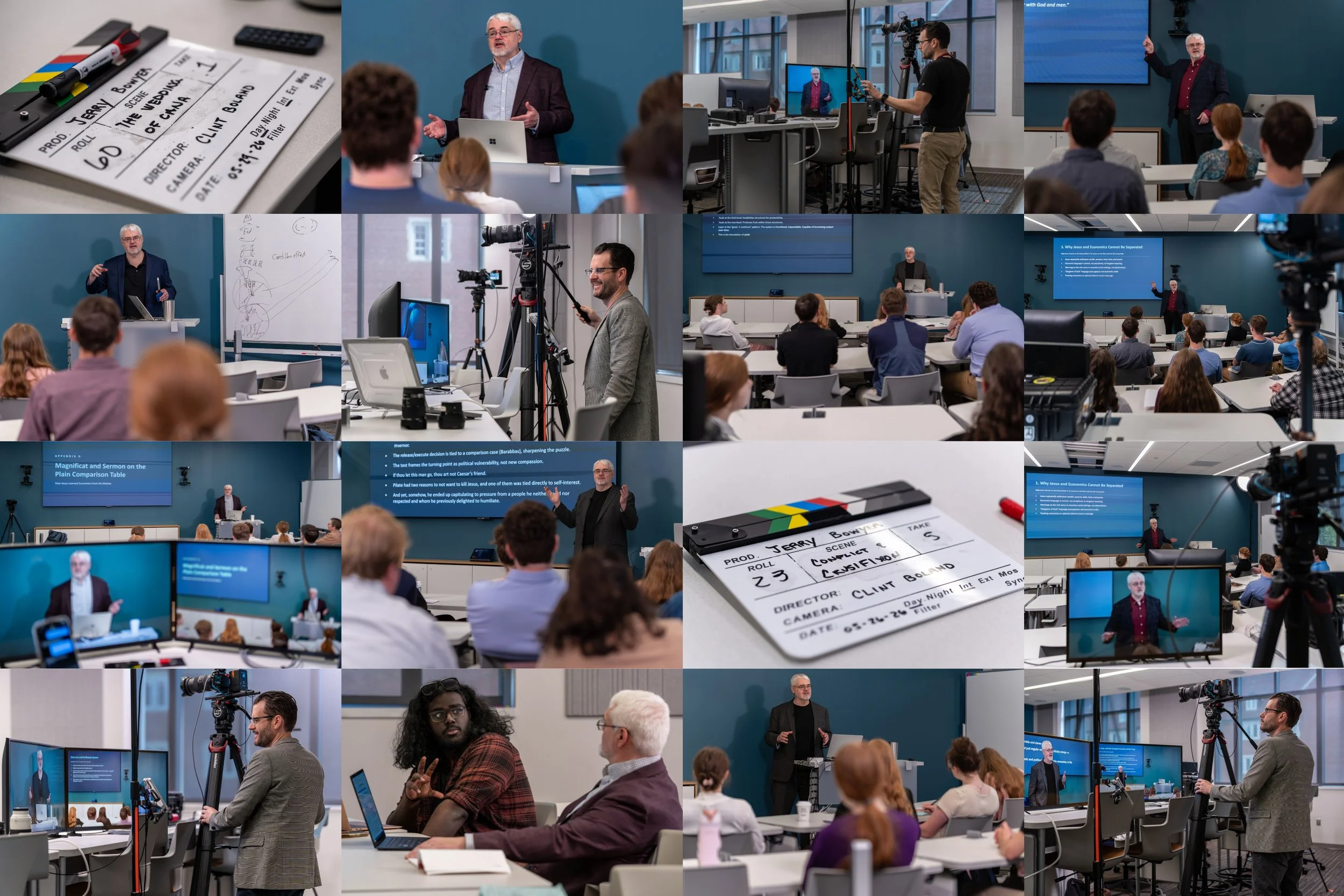
Cinematic three-camera course production for financial economist Jerry Bowyer with the Discovery Institute at Grove City College, featuring Jerry teaching at the front of the classroom, the production crew operating cinema cameras on tripods, confidence monitors displaying the live feed, the course slides on screen, students engaging with the material, and the production slate marking each module.
We just wrapped four days of production at Grove City College, about an hour north of Pittsburgh, filming a full course with leading financial economist Jerry Bowyer. This was another project with the Discovery Institute, and the finished course is destined for Southeastern University as an online offering, with distribution to other learning institutions as well. Over four packed days, we filmed 65 complete modules. It was one of the most content-dense and intellectually rewarding shoots we have taken on.
The Subject
The course is built on Jerry Bowyer's book, The Maker Versus the Takers: What Jesus Really Said About Social Justice and Economics. Bowyer is a financial economist, author, and frequent television and radio guest who has spent years studying what the Bible actually says about money, wealth, and economics. The course unpacks his research and teaching on what Jesus said about money, examining the Gospels through the lens of history and archaeology, and showing how those 2,000-year-old teachings still apply to our lives and decisions today.
This was genuinely one of the most interesting courses we have filmed. The material is rich, the teaching is sharp, and it is the kind of content that will deliver value to students for many years to come. When you spend four days immersed in a subject taught by someone who has mastered it, you walk away having learned something real. That is one of the quiet privileges of educational production work.
The Production Setup
We ran a three cinema camera setup paired with professional lighting and lavalier audio capture for clean, consistent sound across all 65 modules. Lavalier mics keep the audio intimate and clear, which matters enormously for a lecture-based course where the spoken word is the entire product. A single audio dropout or inconsistency across that volume of content would be a serious problem, so we monitored carefully from the first module to the last.
Three cameras give the final edit flexibility: a primary framing of Jerry, a secondary angle for visual variety, and a third camera dedicated to crowd reaction shots of the students in the room. Those reaction shots are a valuable addition to a course like this. They show engagement, capture genuine moments of students responding to the material, and give the editor footage to cut to that makes the finished modules feel alive rather than like a static lecture. For a course that students will watch module after module, that variety keeps the visual experience engaging across hours of material.
Filming at Volume Without Sacrificing Quality
Filming 65 modules in four days is a serious logistical undertaking. The challenge is maintaining cinematic quality and consistency across every single module while keeping pace with an aggressive schedule. The lighting has to look identical in module 65 as it did in module one. The framing, the color, the audio levels all have to match so the finished course feels like a unified, professional product rather than a series of disconnected recordings.
That kind of consistency at volume only happens with a deliberate system: locking in the look at the start, keeping every setting documented, and resetting efficiently between modules without ever cutting corners on quality.
Built for the Final Edit
The course will incorporate Jerry's PowerPoint presentation into the final edit, integrating his slides alongside the camera footage so that students get both the teaching and the visual reference material in a polished, cohesive format. Planning for that integration during the shoot, rather than trying to force it in afterward, is part of what makes the final product seamless.
Why This Is the Work We Love
This project sits right in the center of what Trade Street Media does best: cinematic, multi-camera production for educational and course-based content that needs to look professional and last for years. Whether it is for a non-profit, a university, a company building internal training, or an organization producing a course for the public, the goal is the same. Make the content look as good as the ideas inside it.
If you are a non-profit, company, university, or organization that needs cinematic multi-camera production for your courses, training, or events, we would love to talk. This is exactly the kind of work we are built for, and we deliver it anywhere in the country.