
Watch the Event Highlight Film from the conference below.
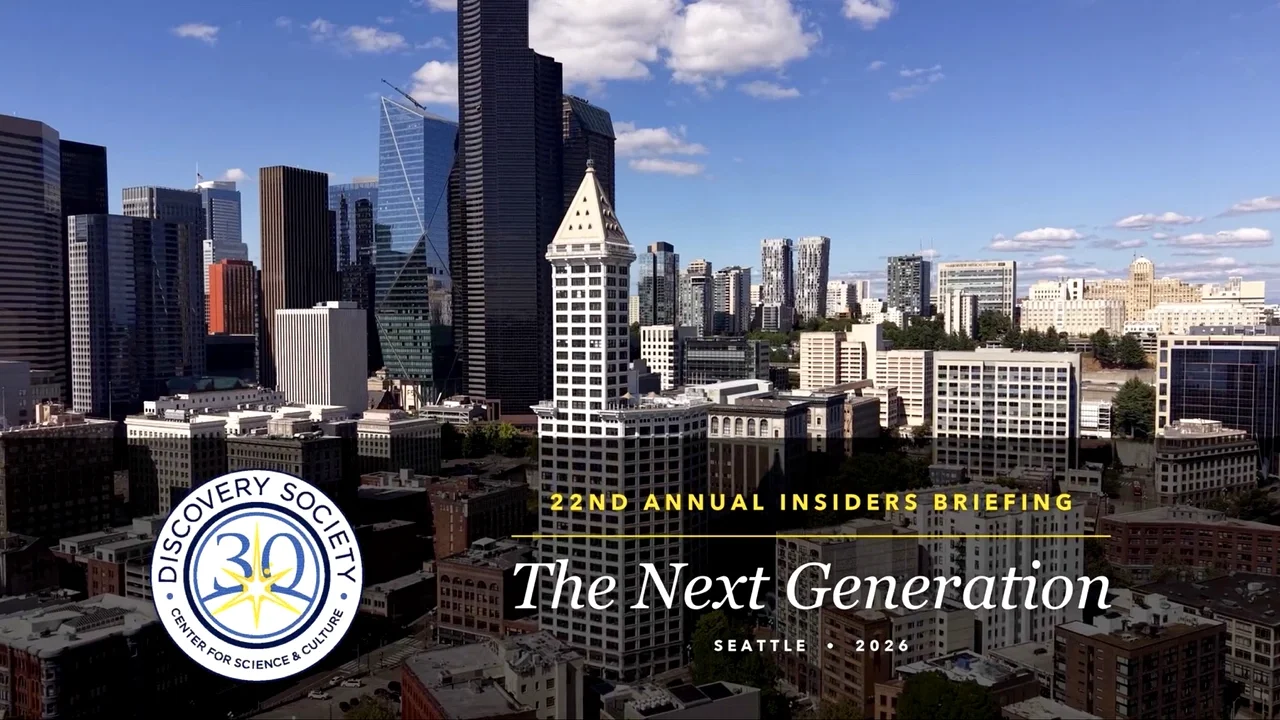
Some events are designed to look toward the future. Others create an opportunity to reflect on the people, ideas, and sacrifices that made the future possible.
Discovery Institute’s 22nd Annual Insiders Briefing accomplished both.
Trade Street Media recently traveled to Seattle, Washington, to provide multi-camera conference video production for the invitation-only gathering. This year’s briefing was especially significant because it commemorated the 30th anniversary of Discovery Institute’s Center for Science and Culture.
Across two days at the historic Fairmont Olympic Hotel and Smith Tower, attendees heard from many of the leading scholars and pioneers associated with the intelligent design movement. The weekend revisited the Center’s beginnings, explored the challenges its scholars faced, presented updates on current research and educational initiatives, and introduced the people preparing to carry that work into the next generation.
For our production team, the assignment was clear: preserve the complete substance of the event while also capturing its energy, relationships, history, and sense of occasion.

Returning to Film the Insiders Briefing
Discovery Institute has been a valued Trade Street Media client for several years, and this was the second Insiders Briefing our team has had the privilege of filming.
Returning for another year gave us an important advantage. We already understood the character of the event, the value of the presentations, and the importance of documenting more than what happened onstage.
This was not simply a conference with a series of lectures. It was a gathering of scholars, supporters, donors, educators, and friends who have invested deeply in Discovery Institute’s mission.
Because this year marked the Center for Science and Culture’s 30th anniversary, the production needed to preserve both the intellectual content and the human story behind it.
I again had the pleasure of working with Kelly Unger to develop the production vision. Over several months, we discussed the schedule, venues, camera coverage, interviews, supplemental footage, audio requirements, and final deliverables.
That planning was one of the primary reasons the weekend ran smoothly.
Events of this scale do not succeed because everyone arrives and hopes for the best. They succeed because the client and production team clarify the vision, anticipate logistical challenges, and make important decisions long before the first camera begins recording.

Celebrating 30 Years of the Center for Science and Culture
The 2026 Insiders Briefing carried the theme The Next Generation.
The weekend celebrated the founders’ original vision, recognized accomplishments from the Center for Science and Culture’s first 30 years, and highlighted the scholars and researchers who will help shape the future of intelligent design.
The official program included Center for Science and Culture co-founders Stephen Meyer and John West, along with Douglas Axe, Michael Behe, William Dembski, Paul Nelson, Jay Richards, Casey Luskin, Steve Dilley, Daniel Reeves, Robert Crowther, Nathan Jacobson, Winston Ewert, and other Discovery Institute leaders and researchers. Discovery Institute
Hearing so many influential figures together was extraordinary.
Attendees heard origin stories from the earliest years of the intelligent design movement and personal accounts of the professional and institutional opposition some scholars endured. Those stories gave greater context to the work being done today and demonstrated the persistence required to challenge established assumptions in science and academia.
There were also updates on current research, scholarship, media, communications, educational outreach, and the development of younger researchers.
The weekend did not remain focused on the past. Its central message was that the work continues.

Looking Toward the Next Generation
Several sessions focused on the researchers, educators, and institutions that will carry the conversation forward.
Attendees received updates on Discovery Institute’s educational initiatives and the continued development of the William Whewell Centre for Science and Natural Theology in Cambridge.
The Whewell Centre provides students and postdoctoral researchers with mentoring, a scholarly community, workspace, library resources, seminars, conferences, and access to visiting faculty. Its broader purpose is to support students with the potential to become future leaders within scientific and academic communities. Discovery Institute
That emphasis on the next generation gave the anniversary greater purpose.
The event was not simply celebrating what had already been accomplished. It was examining how 30 years of scholarship, publishing, research, education, and public engagement can become a foundation for the decades ahead.

Complete Multi-Camera Conference Coverage
One of our principal deliverables is a complete video record of the sessions, lectures, panels, and onstage conversations.
These full-length presentations will allow Discovery Institute donors and supporters who could not attend in person to experience the substance of the weekend.
That requires a different production strategy than filming only a promotional highlight.
A highlight video can move quickly, use short soundbites, and rely heavily on cinematic b-roll. Full-session conference videos must remain visually engaging while preserving every presentation accurately and continuously.
To accomplish that, we deployed a four-camera Sony cinema setup with each camera serving a specific purpose.
Camera One: Tight Speaker Coverage
Our primary camera captured a tight shot of the person speaking at the podium or onstage.
The operator followed speakers as they moved, reacted, turned toward fellow panelists, or addressed different sections of the audience. This angle provides the clear, direct coverage viewers expect from a professionally produced conference video.
Camera Two: Full-Stage Wide Shot
A locked wide camera covered the entire stage.
This provided uninterrupted visual coverage of panels, speaker transitions, presentations, and moments when multiple participants interacted. It also served as an essential safety angle during camera repositioning.
Camera Three: Motorized Slider Perspective
Our third cinema camera was positioned to capture the stage through the audience and mounted on a motorized slider.
The slow lateral movement added depth and cinematic energy without distracting from the presentations. Including the audience in the foreground also helped communicate the atmosphere of the room and the relationship between the speakers and attendees.
Camera Four: Mobile Gimbal Coverage
Our fourth camera was mounted on a gimbal and operated from different positions throughout the room.
This allowed us to capture dynamic speaker angles, audience reactions, venue details, transitions, conversations, meals, and moving shots for the final highlight video.
The gimbal camera gave us the flexibility to tell the broader story of the weekend while the other cameras maintained dependable coverage of the stage.

Professional Audio From the Venue Sound System
Excellent visuals cannot compensate for poor conference audio.
The ideas being presented were the reason people gathered, so every lecture and conversation needed to be recorded clearly.
We received a professional XLR audio feed from the onsite audiovisual team and routed it into our camera and recording workflow. Working from the venue’s sound-system feed gave us direct access to the podium microphones and other stage sources.
Coordinating with an onsite AV provider is a critical part of conference video production. Our team verifies signal levels, connectors, routing, and backup options before the program begins rather than assuming that a usable feed will automatically be available.
The result is clean, intelligible audio that allows viewers to focus on the speaker and the substance of the presentation.

Supplemental Lighting for a More Refined Image
The venue already provided a stage wash, but lighting designed for the people sitting in a ballroom does not always translate perfectly to cinema cameras.
We added supplemental production lighting to improve exposure, facial definition, color, and consistency across the stage.
Our goal was not to make the ballroom look like a film studio. The additional lighting needed to complement the existing environment, remain comfortable for speakers and attendees, and elevate the image without becoming visually intrusive.
The difference can be subtle inside the room but significant in the final footage.
Professional conference lighting helps speakers look natural and polished while giving the cameras enough information to retain detail throughout a long event.

Monitoring Four Cameras From an iPad Pro
Throughout the event, we monitored all four Sony cameras using the Sony Monitor & Control app on an iPad Pro.
This has become a game-changing tool for our event-production workflow.
From one central location, we could continuously evaluate:
Focus
Exposure
Framing
Camera status
Battery and media concerns
Differences between camera angles
Potential recording problems
With multiple cameras operating for extended presentations, small issues can easily go unnoticed. A camera may be slightly soft, a speaker may move outside the intended frame, or one angle may no longer match the others as ballroom lighting changes.
Centralized monitoring allowed us to identify and address those problems immediately rather than discovering them during post-production.
It provided another layer of quality control without requiring a traditional video village or a room full of additional equipment.

Donor Testimonials and the Human Story Behind the Event
Complete lectures will preserve the information presented onstage, but testimonials help explain why the event matters.
We interviewed Discovery Institute donors and supporters throughout the weekend to capture their experiences, personal connections, and perspectives on the Center for Science and Culture’s 30-year legacy.
These interviews will add emotional and narrative depth to the final highlight film.
Instead of relying only on a chronological event recap, the finished video can be structured around authentic voices from people who have supported the mission, followed the work, attended previous gatherings, and developed meaningful relationships within the Discovery Institute community.
Those soundbites provide variety, but more importantly, they communicate impact.
For nonprofit organizations, donor interviews are particularly valuable because they allow supporters to explain the organization’s significance in language that feels personal and credible.

Creating a Dynamic Highlight Film
In addition to delivering the sessions in their entirety, we will produce a dynamic highlight video that encapsulates the complete weekend.
The highlight will bring together:
Key moments from the lectures and panels
Anniversary reflections
Donor testimonials
Audience reactions
Meals and informal conversations
Venue details
The Fairmont Olympic Hotel
Discovery Institute’s new Smith Tower headquarters
Drone footage of downtown Seattle
Cinematic gimbal and slider movement
The energy and fellowship shared by attendees
The goal is not merely to prove that the event happened.
The highlight should allow someone who was not present to understand what the weekend felt like and why it was important.
This type of video can support donor communications, future event promotion, social media, fundraising, organizational storytelling, and the preservation of an important milestone.

Drone Video of the Fairmont Olympic and Smith Tower
The venues were an important part of the story.
Most of the conference sessions took place at Seattle’s Fairmont Olympic Hotel, while the closing event brought attendees to Smith Tower, home to Discovery Institute’s new headquarters.
We captured aerial footage of both locations to establish the event within downtown Seattle and give the final highlight video a stronger sense of scale.
Drone shots of the Fairmont Olympic provide an elegant introduction to the primary conference location. Aerial footage of Smith Tower creates a natural transition to the closing celebration and the next chapter in Discovery Institute’s history.
Establishing footage is especially valuable for national organizations. It immediately communicates where the event took place and helps a viewer move visually from one venue to another.

Touring Discovery Institute’s New Smith Tower Headquarters
The weekend concluded at one of Seattle’s most recognizable landmarks.
Attendees traveled from the Fairmont Olympic to Smith Tower, where they toured Discovery Institute’s new offices and experienced several of the building’s historic spaces. The official closing program included the Institute’s 17th-floor offices, the Florence Room, Lookout Lounge and outdoor deck, and Smith Tower Observatory. Discovery Institute
Memorabilia from the Center for Science and Culture’s first 30 years was displayed throughout the closing event, connecting the organization’s history with its new home.
It was a fitting way to conclude the anniversary.
The evening combined history, architecture, meaningful conversations, wonderful food, laughter, and the excitement of seeing where Discovery Institute’s next chapter will unfold.
From a production standpoint, it also gave us an entirely different visual environment to capture. The transition from the Fairmont’s ballroom to the historic rooms, city views, offices, and observation areas of Smith Tower will give the highlight film greater visual variety.

Why Pre-Production Matters for Conference Video
The success of this production began several months before we arrived in Seattle.
Kelly and I worked closely to define what Discovery Institute needed to preserve, who the intended audiences were, which moments required complete coverage, and what footage would be needed to construct a compelling highlight film.
Our pre-production process included planning for:
A multi-day schedule
Two principal venues
Four-camera coverage
Stage and podium movement
Audio integration with the onsite AV vendor
Supplemental lighting
Donor testimonials
Drone operations in downtown Seattle
Gimbal and slider footage
Equipment movement between locations
Complete presentation deliverables
A cinematic anniversary highlight video
Good event production should feel calm to the client.
That calm is created by answering questions early, preparing equipment carefully, coordinating with the venue and AV team, and developing a clear plan for every deliverable.
Events do not run smoothly by chance. They run smoothly because both parties prepare well and communicate consistently.

More Than a Client Relationship
We genuinely love serving Discovery Institute.
They are a wonderful organization and an exceptional client, but our connection to the work extends beyond the production itself. The scholars, staff members, and supporters we have met are kind, generous, thoughtful people committed to a mission we personally value.
It is a privilege to help document the work of pioneers who have spent decades advancing ideas they believe are true, even when doing so came at a personal or professional cost.
We do not take their trust lightly.
Our responsibility is to arrive prepared, protect the integrity of the content, solve problems without creating additional stress, and produce videos that serve Discovery Institute long after the event concludes.
The 22nd Annual Insiders Briefing was an unforgettable weekend, and we are excited to begin shaping everything we captured into a finished collection of presentations and a highlight film celebrating 30 years of the Center for Science and Culture.

Frequently Asked Questions About Conference Video Production
How many cameras are needed to film a conference?
The ideal number depends on the stage layout, number of speakers, intended deliverables, and available crew. A four-camera setup can provide tight speaker coverage, a dependable wide shot, an audience perspective, and a mobile cinematic angle without interrupting the event.
Can conference sessions and a highlight video be filmed at the same event?
Yes. However, the camera plan must account for both deliverables. Complete session recordings require continuous, dependable coverage, while a highlight video also needs audience reactions, venue details, interviews, transitions, movement, and establishing footage.
How do you record professional audio at a conference?
Whenever possible, the video-production team coordinates with the onsite AV provider to receive a direct audio feed from the venue’s sound system. Independent or redundant recording may also be used depending on the event and available equipment.
Are donor testimonials valuable for nonprofit events?
Yes. Donor testimonials add personal context and allow supporters to explain why the organization matters in their own words. These interviews can strengthen highlight videos, fundraising campaigns, anniversary films, social media content, and donor communications.
Does Trade Street Media travel for conference video production?
Yes. Trade Street Media is based in the Charlotte area and provides conference, event, interview, livestream, and multi-camera video production throughout the United States and internationally.
Planning a Conference or Anniversary Event?
Trade Street Media provides professional conference video production, multi-camera event coverage, interviews, livestreaming, event photography, and highlight films for organizations in Charlotte and across the United States.
We regularly travel for conferences, donor events, educational programs, nonprofit gatherings, corporate meetings, lectures, and multi-day productions.
Whether your event requires complete presentation recordings, cinematic promotional content, donor testimonials, aerial video, social media deliverables, or a combination of each, our team can build a production plan around your venue, audience, schedule, and long-term goals.